Remove Lubricant, Eliminate Soot, and get a better sinter in a single process

soot

Don’t have time to read this article? Click here to watch it instead!

Automotive products made with powder metallurgy can be smaller, lighter, more dense, and more heat resistant than those made with other methods. That’s important for today’s precision vehicles and ever-growing demand for fuel efficiency in internal combustion engine vehicles and longer battery range in electric vehicles (EV). Common powder metallurgy manufacturing applications include: 

  • Bearings
  • Gears
  • AC motor stators
  • Engine and transmission components
  • Shock absorber parts
  • Seat adjustment parts

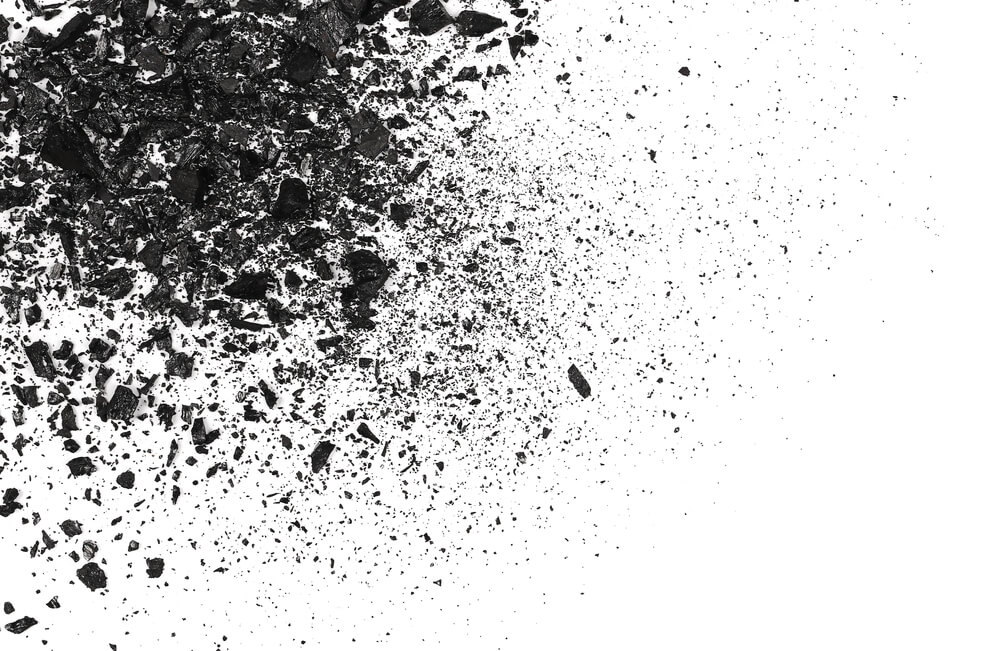
One of the biggest challenges with this manufacturing process is removing all lubricant from green compacts, which is critical to achieving a proper sinter. Leftover lubricant leads to the formation of soot in and on parts during sintering, which impacts the strength and performance of the finished part, as well as the system it goes into.

Convective vs. Radiant Heat

The commonly accepted rule of thumb for lubricant removal is 20 minutes in a radiant heat style preheating section of a sintering furnace that’s set to temperatures that are between 1,200° F to 1,800° F. This should allow the lubricant to melt and run out of the compacts. However, at particle densities over 6.6 g/cc or higher (which is common across manufacturers), this approach becomes less and less effective. In fact, as density increases and pore size decreases, lubricant removal time increases exponentially. This creates a major bottleneck to production and is not sustainable.

Recent research by Coble, et. al. involving ethylene bis-stearamide (EBS) lubricant, which is a standard lubricant in the powder metallurgy industry, examines this traditional approach to lubricant removal and an alternative method.

soot from sinteringThe data sheet for a typical EBS lubricant product indicates a melting point of 284˚F and boiling point of 500˚F. While the melting point was able to be verified by Powel, et. al., the boiling point was not. In fact, the lubricant remained in green compacts at temperatures as high as 1011˚F, at which point the lubricant turned to carbon (i.e. soot).

The researchers concluded the optimal temperature range for removal is 350˚F to 1000˚F. The challenge is that the radiant heat used in most furnaces doesn’t penetrate the compact consistently in this range. Instead, convective heat is required.

Why is an Integrated Furnace System Better than Add-ons?

Creating a separate convection heat zone within the furnace makes it possible to heat parts evenly to the precise temperature. An internal conveyor ensures parts stay in the chamber for the correct amount of time. It’s also critical to introduce moisture to the chamber to regulate the atmosphere and facilitate breakdown of the lubricant into hydrogen and carbon monoxide. By controlling temperature, exposure time, and atmosphere in this way, soot is avoided.

In conventional furnaces, workaround solutions include installing muffle extensions to pre-heat parts, or adding nitrogen bubblers or other systems to inject moisture. However, more precise control over these variables is possible with an integrated furnace system.

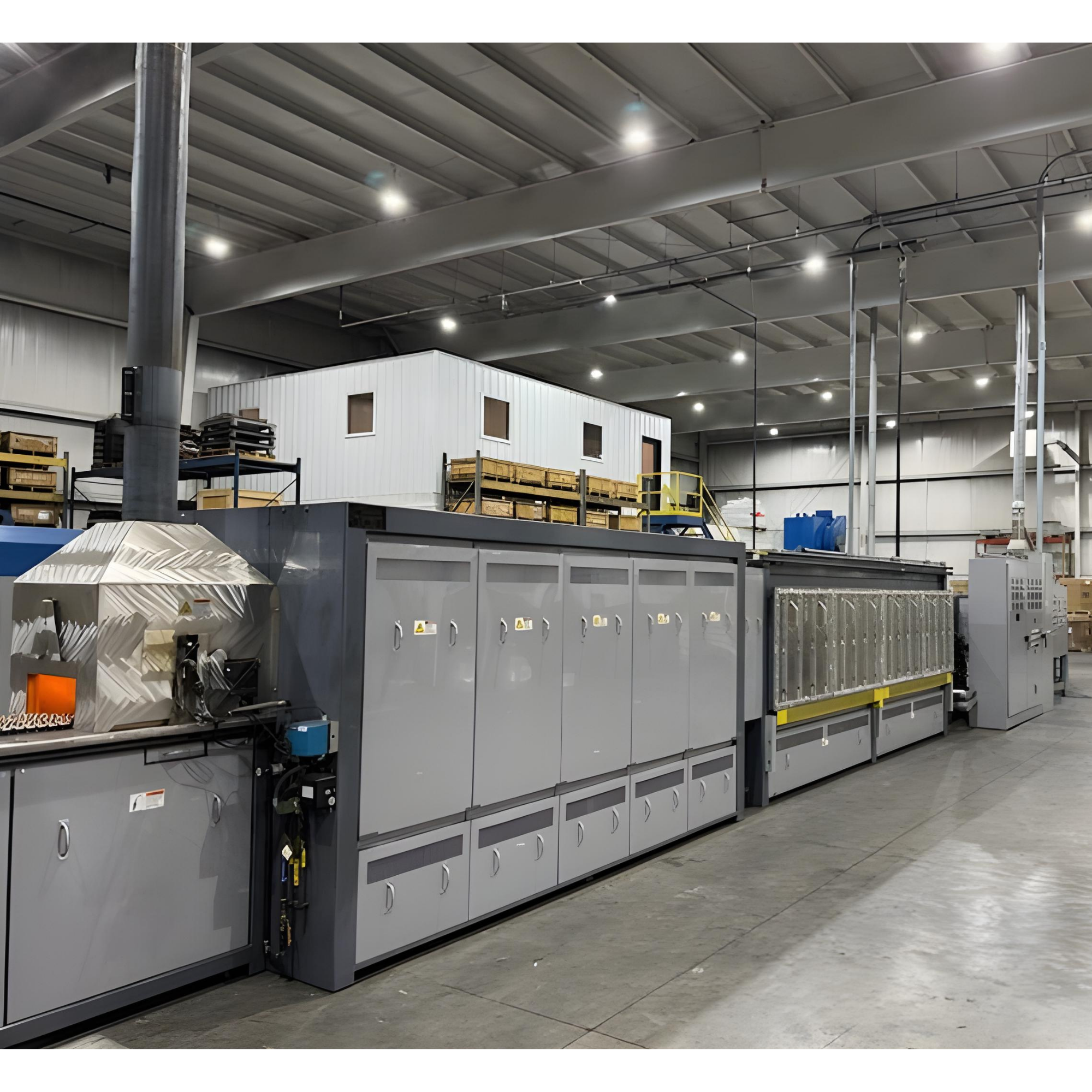
An example is Abbott’s Vulcan process, which is engineered for flexibility and complete control over temperature, time in each zone, and atmosphere flow rate and composition.

This process works with a wide range of loading configurations, part sizes and densities, so it is flexible enough to accommodate a diverse current repertoire as well as future innovations.

Watch our webinar to learn more about lubricant removal.

Demonstrated Benefits to Properties and Productivity

A great advantage of a system like this is that the equipment for convection heating, regulated conveyance, and atmospheric control are part of the furnace design, and all controls and instrumentation are integrated. This allows you to set the exact process parameters required for each product and make fine adjustments easily. It’s not “good enough” but rather “just right” every time.

Another advantage is the improved mechanical properties of powder metal parts made using the Vulcan process. That means a better overall product. For example, research has shown the following results (depending on particle density):

  • Transverse rupture strength
    • 18 percent increase with single stack
    • 4 percent increase with double stack
  • Rockwell B hardness
    • 4 to 6.3 percent increase with single stack
    • 6 to 5.8 percent increase with double stack
  • Improved sinter indicated by rounder pores resulting from complete lubricant removal.

This system also lets manufacturers meet production priorities by single or double stacking parts as desired. For example, the research cited above indicates that compared to a conventional furnace the Vulcan process can achieve:

  • Better mechanical properties at the same rate of production, or
  • Comparable mechanical properties at twice the rate of production

Depending on manufacturing goals, it’s possible to increase production or improve properties as needed for each component in production.

At Abbott Furnace Co., we’re committed to providing innovative industrial furnace equipment as well as the research to back it up – please contact us to talk about your goals for lubricant removal, sintering, and product development!

Abbott Furnace Optimization Webinar

Furnace Optimization webinar replay (Presented in Spanish)

OPTIMIZE YOUR BRAZING FURNACE Lower Costs. Same Quality. Greater Competitiveness. The greatest opportunity for savings in your brazing operation may not be during production — it may be during idle time. Join Abbott Furnace Company for this free webinar focused on practical strategies to optimize the operation of continuous brazing furnaces during production downtime. Learn

Read More »
Abbott Furnace Company in the News

Stephen L. Feldbauer, Ph.D. Featured in Heat Treat Today

Abbott Furnace Featured in Heat Treat Today | April 2026 Abbott Furnace Company is honored to be featured in the April 2026 edition of Heat Treat Today in the article: “Hydrogen Part 1: Powerful Reducing Properties, High Thermal Conductivity” The feature includes expert insight from Stephen L. Feldbauer, Ph.D., Head of Research & Development at

Read More »
Abbott Furnace Continuous Furnace & Brazing Symposium

Abbott Furnace 2026 Continuous Furnace & Brazing Symposium Recap

Industry Professionals Gather for Two and a Half Days of Technical Education, Networking & Innovation Abbott’s 2026 Continuous Furnace & Brazing Symposium brought together industry professionals from across the thermal processing, powder metallurgy, brazing, heat treating, and advanced manufacturing industries for two and a half days of technical education, collaboration, and networking. Held in Louisville,

Read More »
continuous belt furnace

Abbott Furnace Company Delivers 7-Zone Sintering Furnace to Metco Industries

FOR IMMEDIATE RELEASEMarch 2026 Abbott Furnace Company Delivers 7-Zone Sintering Furnace to Metco Industries St. Marys, PA — Abbott Furnace Company has successfully delivered and commissioned a seven-zone continuous belt sintering furnace for Metco Industries. The system incorporates Abbott’s latest generation of fully digital atmosphere control technology, engineered and manufactured in-house. The system is designed

Read More »
Abbott Furnace Construction Comparison Webinar

Furnace Construction Comparison- Light Construction vs Abbott Furnace Construction webinar replay (Presented in Spanish)

Not all industrial furnaces are built the same, and those differences matter when uptime, reliability, and long-term operating cost are on the line. In this technical webinar, Abbott Furnace experts will break down the key design and construction differences between typical “light construction” furnaces and Abbott’s heavy-duty furnace construction, examining how these choices impact performance,

Read More »
Translate »
Scroll to Top